Spain's National Day is one of the most important dates on the country's calendar, representing a moment of unity, historical reflection, and cultural celebration. Every October 12th, the streets fill with flags and official events commemorating Spanish identity and its international standing. This holiday, regulated by law, is not only a public holiday throughout the country but also an opportunity to delve into the roots that shape contemporary Spain. When planning your year, it's essential to consult the 2025 calendar of public holidays in Spain to understand how this day fits into the daily lives of citizens and institutions.
What is Spain's National Day and why is it celebrated on October 12th?
The choice of October 12th as Spain's National Day is neither accidental nor arbitrary. It commemorates an event that changed the course of world history: the arrival of Christopher Columbus's expedition to the shores of Guanahani Island, in the Bahamas archipelago, in 1492. This event marked the beginning of prolonged contact between Europe and the Americas, leading to an unprecedented cultural, linguistic, and political transformation. Law 18/1987, which establishes this date as a national holiday, emphasizes that its purpose is to solemnly remember moments in collective history that form part of our shared heritage.
From an institutional perspective, Spain's National Day seeks to reaffirm the unity of the State and its fraternity with nations that share historical and cultural ties with our country. Although popularly known for decades as Hispanic Day, the current legal term is National Day of Spain, a name that aims to unite all Spaniards under a shared sense of belonging, regardless of their regional origin or personal beliefs. It is one of the important dates in Spain that no one should overlook if they wish to understand the country's unique character.
Historical evolution of the name and date
The commemoration has gone through several stages before becoming what we know today. At the beginning of the 20th century, during the reign of Alfonso XIII, the so-called Día de la Raza (Day of the Race) was instituted, a term that would seem anachronistic today but which at the time was intended to celebrate the union of Spanish-speaking peoples. Over the years and with changes in political regimes, the name evolved. During the dictatorship, the imperial and religious character was emphasized, while with the arrival of democracy, a more inclusive formula was sought, one more in line with a social and democratic state governed by the rule of law.
In 1982, a royal decree already referred to the National Day of Spain and Hispanic Heritage Day, but it was the aforementioned 1987 law that simplified the name to focus on the concept of the Spanish nation. This regulatory change eliminated the reference to Hispanic heritage from the official title of the holiday, although the term remains very much alive in everyday language and in celebrations that link Spain with Latin America. It is important to note that, as it is a non-substitutable national holiday, its celebration is uniform in all autonomous communities, from Galicia to Andalusia, including the islands.
What is the military parade like on October 12th in Madrid?
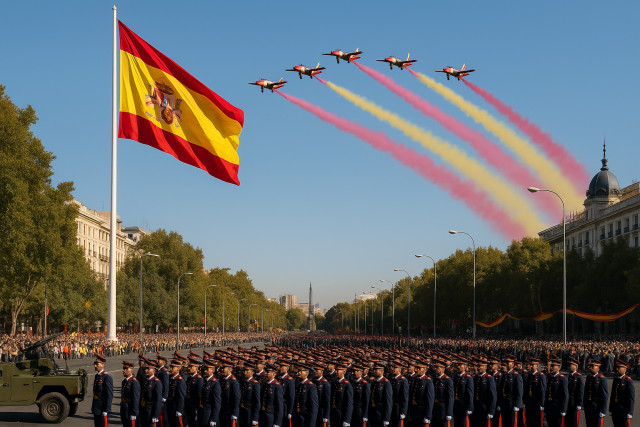
The central and most publicized event of Spain's National Day is undoubtedly the military parade that marches along Madrid's main thoroughfares. This event attracts thousands of people who crowd the sides of the Paseo de la Castellana and the Paseo del Prado to witness the deployment of the Armed Forces, the Civil Guard, the National Police, and other security and emergency services. The parade is not only a display of technical and human resources, but also a significant ceremonial event attended by the highest authorities of the State.
The day begins with the arrival of Their Majesties the King and Queen at the square where the royal box is located. After receiving the corresponding military honors, one of the most moving moments takes place: the raising of the national flag and the tribute to those who gave their lives for Spain. This ceremony usually includes a parachute jump by a member of the Spanish Air Force's Parachute Demonstration Team (PAPEA), who descends from the sky carrying a large national flag which, after landing with precision, is raised while the national anthem plays.
The role of the Royal Family and the authorities
The King's presence, as Supreme Commander of the Armed Forces according to the Spanish Constitution, is the central element of the event. Alongside him are usually the Queen, the Princess of Asturias, and Infanta Sofía, symbolizing the continuity of the Crown. The Prime Minister, the ministers, the presidents of the autonomous communities, and the leaders of the main political parties gather in the official stand. This image of institutional unity is one of the most powerful messages projected during Spain's National Day.
After the ground parade, which includes units on foot, motorized units, and mounted units (such as the spectacular Royal Guard and the Legion with its distinctive goat), comes the air show. The Patrulla Águila (Eagle Patrol) closes the event, painting the colors of the Spanish flag in the Madrid sky with red and yellow smoke. Once the parade is over, the King and Queen travel to the Royal Palace to host an official reception for a broad representation of Spanish society, including figures from the worlds of culture, sports, business, and science.
What to do during the Pilar long weekend in Spain
Since October 12th coincides with the feast day of Our Lady of the Pillar, patron saint of the Hispanic world and the Civil Guard, many people take advantage of this date to enjoy what is known as the Pilar long weekend. If the holiday falls near a weekend, it becomes the perfect excuse to travel to Spain and discover its many autumnal charms. The weather at this time of year is usually mild, making it ideal for outdoor activities and cultural visits.
Zaragoza is undoubtedly the epicenter of religious and popular celebrations during this time. The Fiestas del Pilar attract visitors from all over the world, with the Flower Offering being a highlight, where thousands of people dressed in regional costumes lay millions of flowers at the feet of the Virgin in the Plaza del Pilar. It is a spectacle of color and devotion that showcases the richness of Spanish folklore. But beyond the Aragonese capital, many other cities organize fairs, medieval markets, and concerts to celebrate Spain's National Day.
Museums and monuments with free admission
One of the great advantages of celebrating Spain's National Day in major cities is the open house at numerous museums and palaces managed by Patrimonio Nacional (National Heritage) and the Ministry of Culture. In Madrid, iconic landmarks such as the Royal Palace, the Prado Museum, the Reina Sofía Museum, and the Thyssen-Bornemisza Museum often offer free admission or special activities on October 12th. It's a unique opportunity for families and tourists to experience art and history at no cost.
In addition to museums, many Civil Guard barracks and military bases organize open days in the days leading up to or following the holiday, allowing citizens to learn firsthand about the daily work of those who ensure their safety. These activities strengthen the bond between civil society and institutions, fulfilling the spirit of the law that regulates the national holiday. If you are in Madrid, you can also enjoy Ibero-American music festivals held in public squares, celebrating the cultural diversity that unites us.
When does October 12th fall in the 2025 holiday calendar?
For those already planning their holidays, it's vital to know that in 2025, October 12th will fall on a Sunday. This has direct implications for the work calendar, as many autonomous communities will choose to move the holiday to Monday, October 13th, thus creating a three-day weekend. However, the final decision rests with each regional government, so it's recommended to check the official calendar of each autonomous community to confirm whether Monday will be a non-working day in your area.
These types of adjustments are common in the Spanish system, which seeks to balance respect for historical dates with productivity and worker well-being. The October bank holiday weekend is traditionally one of the busiest for domestic tourism, as it represents the first major respite after the return to school and the end of summer vacation. Inland destinations like Toledo, Segovia, and Granada typically experience very high occupancy rates, as do coastal areas that are still enjoying pleasant temperatures.
How to take advantage of the October long weekend to travel
If you decide to travel during Spain's National Day, you have many options depending on your preferences. For nature lovers, autumn is the best time to visit the beech forests of Navarre or the Picos de Europa mountains, where the changing leaves create spectacular landscapes. For those who prefer city breaks, cities like Seville or Valencia offer a vibrant cultural scene and a cuisine that in October is enriched with seasonal products such as mushrooms, chestnuts, and game.
- Visit Zaragoza to experience the Pilar Festival in all its splendor.
- Attend the military parade in Madrid and enjoy the free museums.
- Take a route through the white villages of Cadiz, enjoying the mild climate.
- Explore the history of the arrival in America at the Columbian Sites of Huelva.
- Enjoy the autumn gastronomy in northern Spain, especially in Asturias or Cantabria.
Interesting facts about the National Holiday and Hispanic Heritage
Spain's National Day is full of curious details that many people are unaware of. For example, did you know that the flag raised in the Madrid parade is the same one that flies in Plaza de Colón, but with specific dimensions for the event? Or that the air show requires meticulous coordination between the Barajas control tower and the military pilots to avoid disrupting civilian traffic at one of Europe's busiest airports?
Another interesting fact is the origin of Our Lady of the Pillar as the patron saint. Although the national holiday is a secular one, its coincidence with the Virgin's feast day has merged both celebrations in the popular imagination. Furthermore, October 12th is also Spanish Language Day, recognized by the UN, which underscores the importance of Spanish as a unifying force for more than 500 million people worldwide. Celebrating Spain's National Day is, ultimately, celebrating a legacy that transcends borders and continues to evolve over the centuries.
Ultimately, October 12th is much more than just a red day on the calendar. It's a day for coming together, for acknowledging our history with its triumphs and its challenges, and for envisioning a modern, diverse Spain, proud of its identity, for the future. Whether attending a parade, visiting a museum, or simply enjoying a day with family, Spain's National Day invites us all to feel part of a shared project that is renewed each year with fresh enthusiasm.